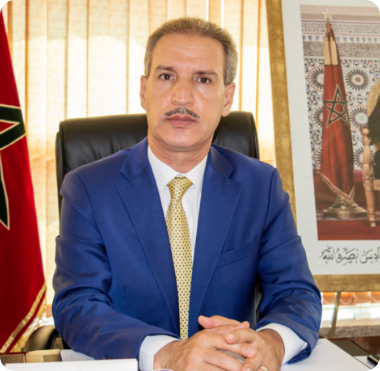
Director of the National Agency for the Fight against Illiteracy (ANLCA)
The National Agency for the Fight against Illiteracy (ANLCA) is fully aligned with the Kingdom’s high national priorities in the areas of human development, social cohesion, and the promotion of equal opportunities. Illiteracy, as a major obstacle to inclusion, cannot be regarded as inevitable; it requires a determined, structured, and collective response to combat and reduce illiteracy.
As reaffirmed by His Majesty King Mohammed VI, may God glorify and assist Him, in His Royal Message to the 7th International Conference organized by UNESCO in Morocco in June 2022, the national literacy program goes far beyond the acquisition of reading and writing skills. It is also a lever for professional integration, through the development of competencies and the promotion of income-generating projects.
Since assuming my official responsibilities of leading the agency in January 2023, I have been honored to contribute to the momentum already underway in the fight against illiteracy , while pursuing this approach, and convinced of the imperative need to implement a renewed strategic direction aligned with the High Royal Directives, the constitution of the Kingdom, the new development model, and Morocco’s international commitments, including the sustainable development goals and the Marrakech Framework for Action adopted at the 7th International Conference on Adult Education (CONFINTEA VII).
The period 2023- 2024 marked a turning point with the launch of a participatory process to develop the National Literacy Strategy 2023–2035. Anchored in the ambition to eradicate illiteracy by 2029, in accordance with Framework Law 51-17 on the education, training, and scientific research system, this strategy is built on three main pillars: strengthening sector governance, mobilizing human and technical resources, and expanding a diversified literacy offer to all populations and territories concerned.
This strategy is articulated through the 2023–2027 roadmap, which encompasses 20 projects organized around four main axes: targeting, convergence, quality, and governance
In this context, the establishment of the Institute for Training in Literacy Professions (IFMA) represents a cornerstone of the second strategic pillar. The institute aims to improve the quality of learning and to develop the skills of key stakeholders through training programs based on a hybrid approach that combines in-person and remote learning.
The National Agency for the Fight Against Illiteracy (ANLCA) firmly believes that professional qualification is a key driver to improve the literacy process. This aligns with the principle of lifelong learning and contributes to fostering social and economic inclusion.
A qualitative measure was adopted, in line with this approach, through an increase in public funding allocated to programs and its field actors. Furthermore, a labeling system was introduced to classify and evaluate partner associations. An annual national award was also established to recognize the efforts of associations, trainers, and beneficiaries. In addition, direct partnerships have been forged with mega associations with the aim of improving collaboration with civil society.
The Agency has also continued its efforts to digitize all literacy programs through the development of its information systems and digital applications. Moreover, regional action plans have been activated and regional committees institutionalized, in coordination with local authorities and elected councils, thereby strengthening the local and regional dimensions of its interventions.
In this new framework, literacy is integrated into a broader vision of lifelong learning, enabling every citizen to acquire the knowledge and skills necessary to exercise their rights, actively participate in social and economic life, and adapt to continuous changes.
The ANLCA remains fully committed to intensifying its efforts, in line with the enlightened Royal vision, to ensure quality education for all. An education that promotes access to knowledge, communication, integration into the labor market, and the advancement of both individuals and society.
We will continue to operate with openness and collaboration, involving all partners and stakeholders, so that together we can overcome this challenge. and meet the aspirations of His Majesty King Mohammed VI, may God protect Him, and those of the Moroccan people.
Promoting literacy is an investment in social justice, inclusion, and sustainable development. I extend my sincere appreciation to all those who, through their daily dedication and commitment, bring us closer to achieving our common goal: making the right to education and literacy a reality for all.
Abdelouadoud Kharbouch
Director of the National Agency for the Fight against Illiteracy