For the 2023–2024 period, a total of 763,744 people were enrolled in literacy programs, including 570,507 participants in the level 1 literacy program. Since the 2014 General Census, the cumulative number of enrollees has reached approximately 10 million.
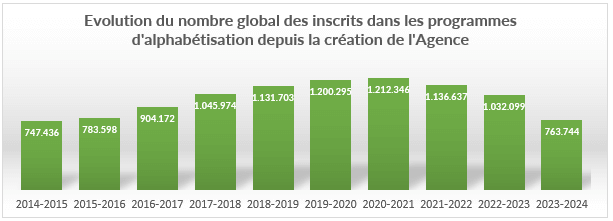
In addition, for the 2023–2024 period, 193,237 participants were enrolled in the post-literacy program (level 2), marking an 8% increase compared to the previous year. Since its inception, the cumulative number of participants in this program has reached 1.7 million.
The breakdown of enrolments by region is as follows:
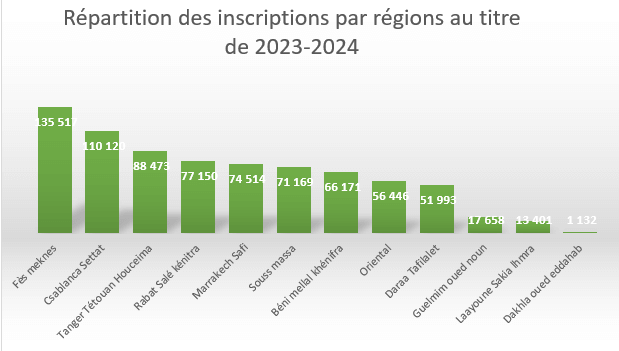
The breakdown of total enrolments for the 2023–2024 period by program type, environment, and gender is as follows:
ALPHA program :
The literacy programs were implemented in collaboration with the following stakeholders: civil society organizations, the Ministry of Habous and Islamic Affairs, other public players and the private sector. Here is a summary of implementation by stakeholder:
Breakdown of enrolments in literacy programs for 2023-2024 by stakeholder
Stakeholder | Number of participants |
| The agency in partnership with associations | 385.442 |
| Program of the Ministry of Habous and Islamic Affairs | 165.290 |
| Other stakeholders | 19.751 |
| Private sector | 227 |
Total | 570.710 |
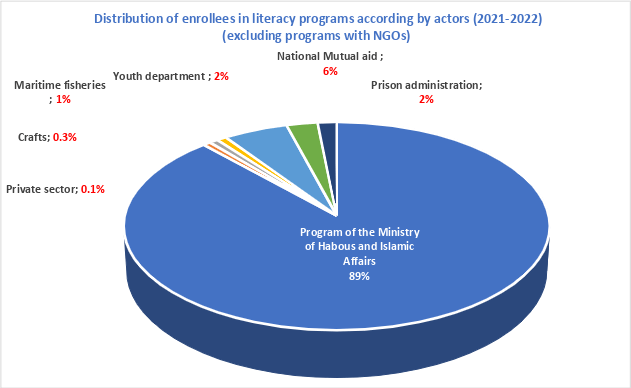
The data presented in the table above highlight the significant contribution of the program implemented in partnership with associations, which accounts for 67.5% of total enrolments. This is followed by the program of the Ministry of Habous and Islamic Affairs, representing 29%, while the remaining government sector programs contribute 3.5%. The figure below provides further details.
In the 2023-2024 period, rural participants in the ALPHA program numbered 356,493, accounting for 62% of total enrolments. Urban enrollees made up the remaining 38%, with 214,217 registrants. Notably, women represented approximately 81% of all enrollees, totaling around 461,264, while men accounted for 19%, or about 109,446 participants.
Post-literacy program :
The post-literacy program for 2023-2024 was carried out in partnership with civil society organizations, the Ministry of Habous and Islamic Affairs, the Ministries of Handicrafts and Maritime Fisheries, and the Regional Council of Drâa-Tafilalet, as detailed in the following table:
Distribution of enrollees in the post-literacy program for 2023–2024 by stakeholders
Actors | Number of enrollees |
| The agency in partnership with civil society organizations | 100.365 |
| Program of the Ministry of Habous and Islamic Affairs | 89.301 |
| Department of Crafts | 600 |
| Department of Maritime Fisheries | 900 |
| Daraa Tafilalet Regional Council | 1868 |
| Total | 193.034 |
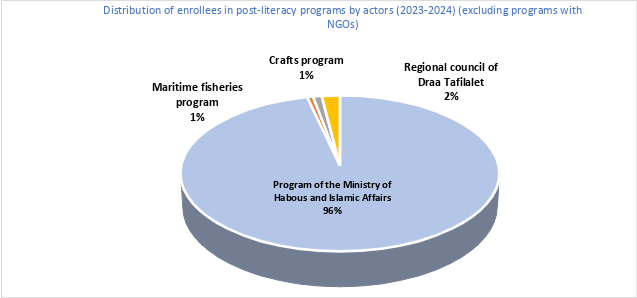
The data in the table above confirms the significant contribution of the program implemented in partnership with associations, which accounted for 52%, followed closely by the Ministry of Habous and Islamic Affairs with 46%. The Regional Council of Drâa-Tafilalet and the Maritime Fisheries sector each contributed 1%, while the Handicrafts program contributed a smaller share.
It is worth noting that the combined contribution of government sectors to the post-literacy program amounted to 92,669 registered participants, distributed as illustrated in the figure below.
Regarding enrollment in post-literacy programs by area of residence, approximately 45% of beneficiaries were from urban areas, totaling 87,301 enrollees, while 55% were from rural areas, with 105,733 enrollees. Notably, women accounted for 90% of the total enrollment in this program, representing 173,741 participants.